Pages

Friday, August 31, 2012

Taking a poke (or two) at the 2012 election

I know, I know, enough with the election stuff already. Maybe some pokes at the election issues will neutralize the vitriol a little.  Of course anything I say will be biased, because it's about a biased situation -- kinda like trying to defend your honor after being accused of lying:  "But, but it's the truth, I swear it..." Then again, I have my favored outcome, too.

When looking for cartoons about the 2012 election, I found collections at two long-established American publications and a publication founded in 1995.  Since I've found a number of cartoonists are featured on GoComics, here's some info about it:
GoComics is a website launched in 2005 by the digital entertainment provider Uclick. It was originally created as a distribution portal for comic strips on mobile phones, but in 2006, the site was redesigned and expanded to include online strips and cartoons. GoComics publishes editorial cartoons, mobile content and daily comics; thus its subtitle toon in daily.
A collection of 29 cartoons by a variety of cartoonists was found at the Washington Post in a slideshow under the heading or "The best cartoons on election 2012." One of the cartoons I like (but am unable to present here) is by Chan Lowe, so here's another of his from GoComics:
***
image: cartoon by Chan Lowe about voter I.D. laws
***

From a now unavailable collection of political cartoons at the New Yorker here's one by Frank Modell that pretty much describes the political thinking this year.
***
image: political cartoon by Frank Modell about the hate vote
***

This one's by John Cole, editorial cartoonist for the Times-Tribune:
***
image: cartoon by John Cole "2012 election:  A new take on jobs"
***

That's a wrap for today, Folks.

-- Marge


Wednesday, August 29, 2012

Checking out Sketchup

SketchUp, a program previously offered by Google but now run by Trimble, is used for 3D modeling and has a number of different types of products.  Follow the Wikipedia link above to get an idea of its capabilities.  The basic program is free; there is a Pro version available.  Look here for the program's hardware requirements.  A Google account is required for some of the functions described below.

Assuming that most of us will be trying/using the free version, that's what I downloaded and installed.  Not having given it a real try, I'm hesitant to make a judgment on its overall usefulness for modeling.  There are some nice features like a tape measure and a protractor.  It took me a while to figure out that I had to tab when creating a line to enter the line length.  Curious thing, no sphere is available as a primitive, you have to build one (tricky) or download one from the 3D Warehouse.

Speaking of the 3D Warehouse, it's the features available through Sketchup that I find more intriguing.

For an example there's Building Maker (accessed through an icon on the upper task bar).  Google describes it thus:
Building Maker is a 3D modeling tool for adding buildings to Google Earth. It's fun to use, and an easy way to get on the 3D map. Here's how it works:
  • Select a city from around the world.
  • Make a building with photos we provide.
  • Save your building and it will be reviewed.
  • See your 3D building in Google Earth!
And there's SketchUp Island, a blog where contests and challenges for SketchUp are featured.

You can preview your model in Google Earth by clicking the Google Earth icon, also in the upper task bar.  A word of warning -- I didn't have a place set so my model showed up in Boulder, Colorado; in fact, it always shows up in Boulder, Colorado. Hmmm....

An image of an area you find in Google Earth is available by clicking on the "Add more imagery..." icon in the upper task bar.  It can become the terrain for your model.

If you tire of trying to build your own model, you can download models built and uploaded by other users by clicking on the cardboard box with a down arrow next to the Google Earth icon.  Then you can adapt them (not all are adaptable).  Some require unlocking, some have the unlock function disabled. Upload your own finished model by using the cardboard box with the up arrow.

What I've listed here are just some of the features in SketchUp and I've only touched on how to use them.

Take a look for yourself -- it's free.

-- Marge


Tuesday, August 28, 2012

Gone fishin'

Researching the metaverse and Google/Trimble Sketchup, I went into overload and bailed for the day.  So...gone fishin', although I've never caught a fish big enough to keep.  I just like to get out and watch the sunlight dance on the water and listen to the trees rustle.

In the meantime you can play a game at National Geographic Kids.

Or you can listen to Bing Crosby and Louis Armstrong sing about it:
***
***

Or you can take a moment for meditation:
***
***

Gone fishin'...

-- Marge


Monday, August 27, 2012

Rainy Bluesy Monday

Here in Anchorage winter's moving in.  Yesterday the wind howled and rattled the trees and it rained most of the day.  In keeping with the mood I'm serving up some blues 'cause I like them.  My friend Shal, who sang with a band called Java, is my blues mama; she recommends artists and sends me links to their music.

Here are five for Monday, plus an irresistible cut from the movie "Blues Brothers":

Bernard Allison - "Chills and Thrills" (2008):
***
***

Jonny Lang - "Lie to Me":
***
***

Coco Montoya - "It's My Own Tears":
***
***

Bonnie Raitt - "Love Me Like a Man" (live):
***
***

Blues Brothers - Think (Aretha Franklin):
***
***

Hmmmm, the sun just came out.

-- Marge


Friday, August 24, 2012

Trying-to-stay-awake Friday...

...need more coffee.

Ah, coffee, where would we be without it.  It has benefits, y'know.  Amanda Chan at The Huffington Post says:
But studies show that we may be benefitting [sic] from more than just the energy-boosting caffeine in coffee -- we might also be reaping its cancer-preventing and depression-lowering effects, just to name a couple.

A number of sites are dedicated to coffee or feature coffee humor pages.  Examples are CoffeeFair and ivman's blague.
***
image: "No coffee No Workee" from the Coffey Haus
***

Cartoonist Randy Glasbergen must like coffee a lot; from his coffee-humor pages there's this:
***
image: cartoon by Randy Glasbergen
***

Funny how you suddenly wake up at the end of the "it's my Friday" workday.


-- Marge


Monday, August 20, 2012

Documentary photography

This post was inspired by photographer J.J. Bentley, who posts regularly to Google+.

JJ's work reminds me of that by Dorothea Lange, Robert Frank, and Elliott Erwitt.  Many of Dorothea's most memorable photos come from work done during the Depression.  Robert Frank traveled across America taking photos; his major work, a book titled The Americans, is said to have redefined photography and documented "the tensions between the optimism of the 1950s and the realities of class and racial differences. (Wikipedia, Robert Frank article) "  Elliot Erwitt is one of my favorite photographers included in the exhibit, "The Family of Man" (which is also available in book form).  This exhibit was shown worldwide and drew crowds wherever it was shown according to MoMA's blog, Inside/Out.  Here is an Erwitt photo from The Family of Man exhibit that is featured in an article in the New York Times blog Lens:


All of these photographers work in a field called documentary photography.

JJ's work is augmented with interviews of his subjects and comments on what he sees.  He has a website that's pretty cryptic; but his posts to Google+ are far more illuminating:

The Worthy Xavier:

image: photo by J.J. Bently, "The Worthy Xavier"

The Unguarded:

image: photo by J.J. Bentley, "The Unguarded"

Leave It on the Ground:

image: photo by J.J. Bentley, "Leave it on the Ground"

To me it's the substance of documentary photography that makes it beautiful.

-- Marge

Friday, August 17, 2012

Cartoons for this moment: Anarchism

Anarchism is the trending topic at this hour (9:00A Alaska Daylight Time).  For this Friday post I'm offering cartoons on the topic.

As background:  In response to a Russian court handing two-year sentences to 3 members of the feminist rock band Pussy Riot for staging an anti-Kremlin protest in a church, thousands of people have expressed support.  Here, from the article "Petitions and pranks as world supports Russian female punk rock band" by Olzhas Auyezov and Andrea Burzynski for Reuters:
Inside Russia, many people were offended when the three women stormed the altar of Moscow's Christ the Saviour Cathedral in February wearing bright-colored masks and clothes to hold a "punk prayer" to get rid of President Vladimir Putin.

Sensitivity inside the overwhelmingly Orthodox Christian country is not shared overseas, however, where media coverage of the trial ahead of Friday's verdict has often cast the women as victims of an oppressive state led by an authoritarian leader.
Disclaimer:  While the topic is not funny for the members of the band and those protesting or members of the Orthodox Christian community, a little humor helps ease the tension and may illuminate in ways we didn't expect.

The 3 cartoons below are from Sidewalk Bubblegum, the Comics about Authority, Police, State Control category, and drawn by Clay Butler.
***
image: cartoon by Clay Butler,"No rest for the wicked"
***
image: cartoon by Clay Butler,"Celebrate the moments of your life"
***
image: cartoon by Clay Butler,"Trouble in paradise"
***

Yikes, another trend to chase -- BP stock is shooting up.

-- Marge

Thursday, August 16, 2012

Kinetic sculpture

Alexander Calder is probably best known for creating the first moving sculpture in modern times, dubbed mobile by Marcel Duchamp (a truly interesting character).  This example of Calder's work comes from the Park West Gallery blog; it shows one of his mobiles installed in the Guggenheim Museum.

image:  Calder's "Red Lily Pads" at the Guggenheim Museum
Alexander Calder:  "Red Lily Pads" (Nénuphars rouges), 1956.
Kinetic art/sculpture has come a long way since then.  Often artists work to make their installations as immersive as possible.

This first video shows several works installed in Atlanta.  It's one of the best videos I've seen on art with each artist telling what he/she had in mind when creating the work and talking about the viewers' responses.


This next video shows the world's largest kinetic art sculpture, installed in Singapore.  How it was created is quite different from those seen in Atlanta.  The technological level is very high.


Excuse me while I go collect the parts for my next piece.

-- Marge

Tuesday, August 14, 2012

Truthiness and the art of Stephen Colbert

Last week Stephen Colbert reported in his "Who's Honoring Me Now?"(August 9, 2012) segment of the Colbert Report that a study reported in the Psychonomic Bulletin & Review verified his concept of  "truthiness."  The researchers, scientists from Canada and New Zealand, said about their work:
"We wanted to examine how the kinds of photos people see every day — the ones that decorate newspaper or TV headlines, for example — might produce ‘truthiness,’” the lead researcher, Eryn J. Newman of Victoria University of Wellington, explained. “We were really surprised by what we found."
You can read about their project and findings in the article -- Cognitive researchers find truth in Colbert’s ‘truthiness’ -- by Eric W. Dolan at the Raw Story.
image:  Stephen Colbert of the Colbert Report from the RawStory
Stephen Colbert
Political satirist Stephen Colbert can sometimes be hard to watch -- he does his satire very well.  Truthiness was the subject of a segment called "The Word," presented during the pilot episode of his weekly program.  You can view that episode on his site Colbert Nation.
Since that initial broadcast the word "truthiness" has gained a foothold in the English language:
Merriam-Webster's #1 Word of the Year for 2006:

1. truthiness (noun)
1 : "truth that comes from the gut, not books" (Stephen Colbert, Comedy Central's "The Colbert Report," October 2005)

2 : "the quality of preferring concepts or facts one wishes to be true, rather than concepts or facts known to be true" (American Dialect Society, January 2006)
And it has been analyzed in the NY Times by Ben Zimmer in his column "On Language."

Not bad for an improv comedian from South Carolina.

-- Marge


Tuesday, August 07, 2012

Nuts and bolts of visual arts, part 1

Most artists like the freedom of creating whatever they damn well please, however they please.  But to communicate effectively in a visual medium, a little learning is a good thing.  There are rules for composition, and design elements to consider.  Remember though, some of the best art breaks at least one of the rules, but probably not all of them.

Marvin Bartel speaks of composition and design from a teacher's perspective. It all boils down to what you want to emphasize in the work and how to present it cohesively. As an artist, you must consider the viewer and direct the viewer's eye.

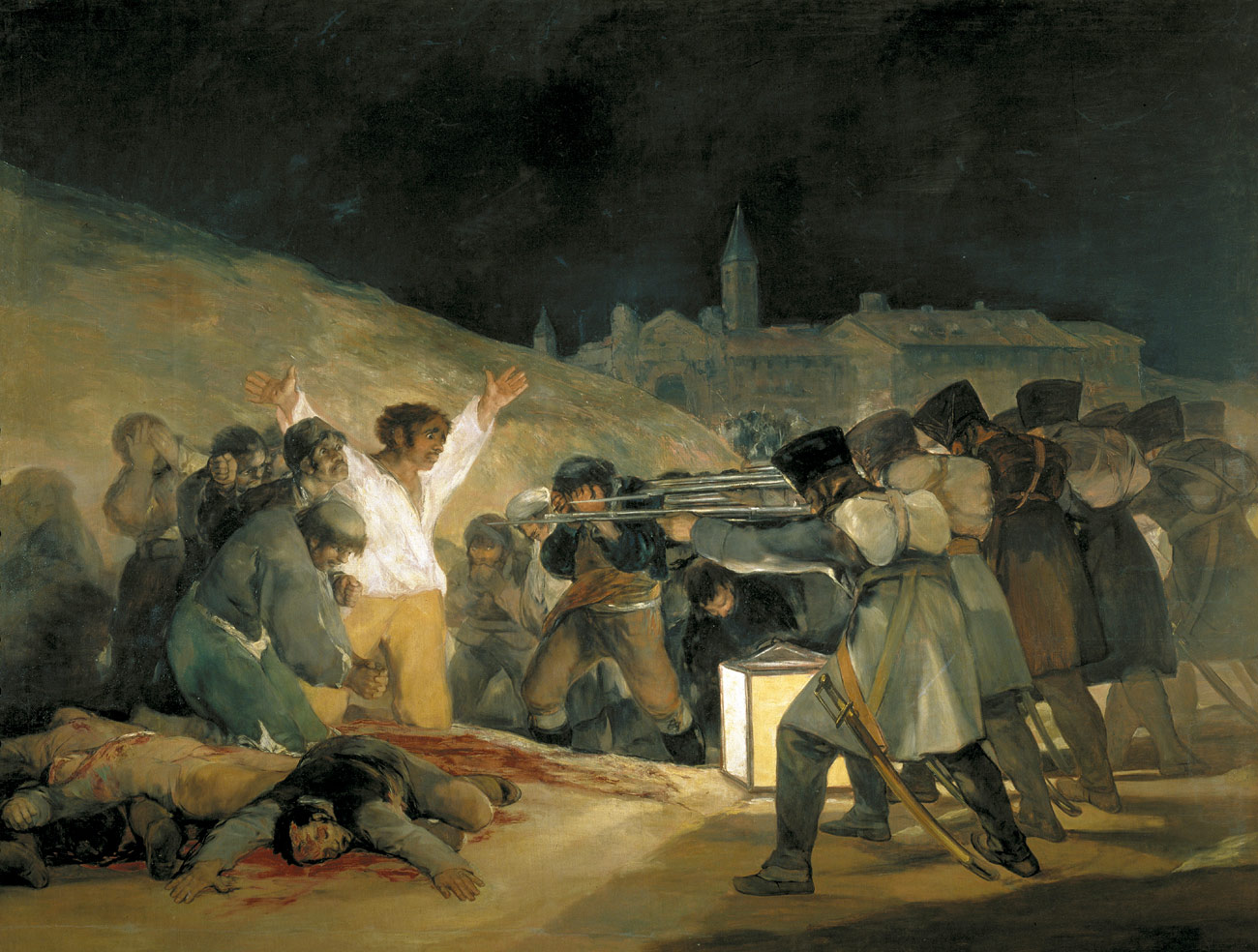
Meaning in art can be elusive.  It's pretty clear in Goya's "The Third of May, 1808" what the artist intended.
***
image:  Goya's "The Third of May, 1808"
***

Van Gogh's rapture is pretty clear in "Starry Night." Note that the Moon isn't in the center of the image; it's almost off the edge. What is in the center is the flow. The trees act as a counterpoint to the Moon.
***
image:  Van Gogh's "Starry Night"
***

But what do you take away from viewing Mondrian's "Composition II in Red, Blue, and Yellow"?
***
image: painting by Piet Mondrian, Composition II in Red, Blue, and, Yellow (1930)
Piet Mondriaan, "Composition II in Red, Blue, and Yellow, Wikipedia
***

Seems to me that some works are done with a message in mind or result in having a message, but some may be just eye candy (or they may have messages few can interpret).  If you have something to say that is larger than what you're working on, that needs to be practiced too.  For an excellent discussion of meaning in art, check out this from a forum at xkcd.


-- Marge


Thursday, August 02, 2012

Managing color on your PC or Mac

A number of factors contribute to the quality of the images and their color as rendered on your PC or Mac.  Devices and applications such as the monitor, the video card, the operating system (OS) and applications for producing and/or editing digital images.  If your machine is out of calibration, you probably won't know it unless you check how your latest webpage or uploaded photo renders on another computer, your smartphone or tablet.

In my humble opinion (IMHO) it's best to adjust your monitor to settings that you find comfortable, then color calibrate using the functions available in your OS.  Then, if using an graphics application, point it to the color, aka "ICC", profile produced by the OS.  In the case of Windows, this is usually a file with the letters "sRGB" in it.

For calibrating your monitor, here are two references:
For calibrating color in your OS and producing a color profile:
Since I don't have a Mac, I don't know much about them.  The article by Kirk McElhearn at Macworld recommends a color calibration device.  This link loads a search on "color calibrator" at Amazon turned up.

In closing here's a mind-bending article on color rendering index (CRI) I found while researching this post and a quote:
Film and video high-CRI LED lighting incompatibility
Problems have been encountered attempting to use otherwise high CRI LED lighting on film and video sets. The color spectra of LED lighting primary colors does not match the expected color wavelength bandpasses of film emulsions and digital sensors. As a result, color rendition can be completely unpredictable in optical prints, transfers to digital media from film (DI's), and video camera recordings. This phenomenon with respect to motion picture film has been documented in an LED lighting evaluation series of tests produced by the Academy of Motion Picture Arts and Sciences scientific staff.

-- Marge


Tuesday, July 31, 2012

xkcd, the webcomic

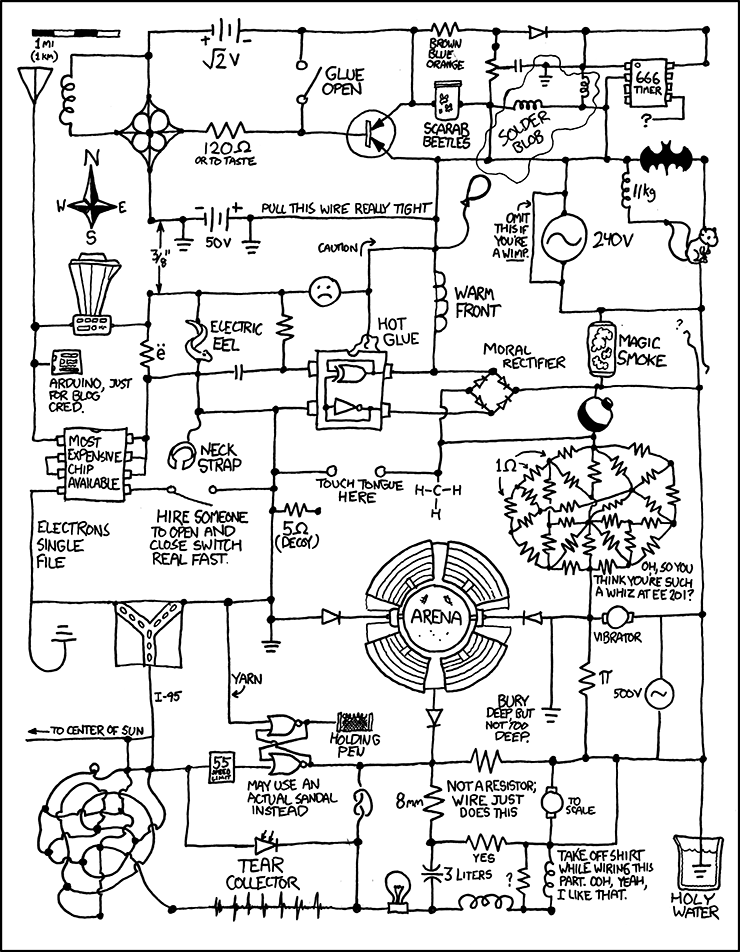
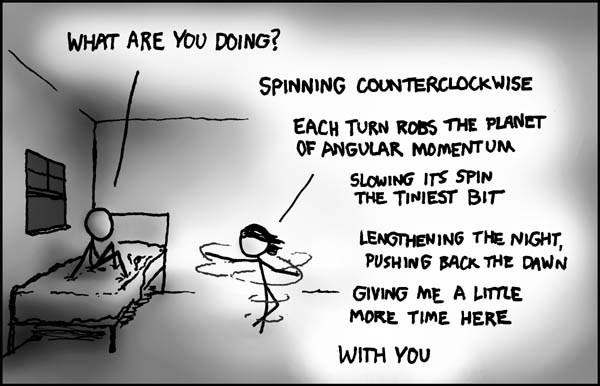
The other day my son, who is a Linux and Perl guru in my eyes, reminded me of the webcomic xkcd, created by Randall Munroe. Here are a couple of my favorite comics and a little about the article "Robot Apocalypse" from the "what if?" section.

Robot Apocalypse is a must read.


Comic:  "Circuit Diagram"
Permanent link to this comic: http://xkcd.com/730/

Comic:  "Angular Momentum"

Permanent link to this comic: http://xkcd.com/162/

Video referred to in "Robot Apocalypse" -- "That scene from War Games"


-- Marge


Monday, July 30, 2012

Friday at the IGCA gallery

The video below shows the exhibit in the International Gallery of Contemporary Art (IGCA).  There were four artists.  Here are the artists' statements from the gallery's blurb:

Oscar Font:
Oscar, aka "VJ offonoll," is an audiovisual artist from Barcelona, Spain, His interactive installations map audiovisual intervention with video projections, using sculpture as a canvas of expression.  He is dedicated to exploring visual communication through nonlinear processes.
Burtner group:
  • Jesse Burtner: 
Jesse is founder and owner of Think Thank, a filmmaking company based in Seattle.  As a filmmaker and professional snowboarder makes frequent trips home to Alaska.
  • Garrett Burtner
Garrett is an Alaska architect and artist working in Anchorage.  He is interested in the interplay of sound and pattern and how these affect the perception of space.
  • Matthew Burtner
Matthew is an award-winning composer, sound artist and professor at University of Virginia.  His work regularly combines instrumental ensembles , computer technology, interactive eco-acoustics and multimedia.
  • "Akropoli"  (title of the work)
At the house where the Burtner brother grew up, if you face a certain direction you will see only mountains.  Then if you turn 180 degrees you will only see the city of Anchorage below you.  At night one side is a dark abyss and the other is the electric town. On a sunny day in the fall one is fresh white sheet the other a gray brown sprawl.  Walk an hour from our door and you could be helplessly lost in wilderness.  An hour 180 degrees in the other direction and you are in urban America.  AKROPOLI (mountain city) is a work about binary qualities of place.  Jesse's video explores the 180 degree aspect described above using split screens and modulated time.  Garrett's visual installation dissects the physical room into a theoretical space of planes and quadrants stretching far beyond the walls and enfolding the exterior spaces (mountain? city? abstract theoretical realms?).  Matthew's interactive music has two parts: a headphone controller part, and a room-speaker/stones part.  In the headphones one viewer listens to the wind and controls a 3-D sound navigator which introduces pulses of noise  In the room, viewers will hear gentle layers of noise as they strike rocks together to make social clusters of rhythm.  As the noise parts urge us towards abstraction, the wind and the room stones relocate us back in the mountain.

Jacob Mattie
Jacob is a DJ whose history of playing music is deeply rooted in the last 11 years of his life in Alaska.  Jump started by working for local record shop, his musical inspirations continue to be driven by artists and producers from around the planet.
"Destiny's Dream Collage" (also uses headphones)  - Mattie has created an interactive interface built of digital and analog devices.  The viewer/listener place a turntable tonearm on a record to experience the composed audio/visual ensemble.

Toridamari group
  • Lucy Toridamari 
Lucy Toridamariis a foreign soul, who glady exchanged Russia for USA as her homeland.  She's in constant search of visual and verbal extravaganza, random beauty and inspiring people.
  • Ryohei Toridamari 
Ryohei Toridamari is an international student from Japan and also a dj, who has collaborated with several art galleries by providing music.
  • Work untitled (also required headphones)


-- Marge


Monday, July 23, 2012

Science: an update on cold fusion

In 1989, a research team at the University of Utah reported that they had produced unexplained excess energy during their electrolysis research.  The Wikipedia article on cold fusion describes their results thus:
Stanley Pons and Martin Fleischmann, then one of the world's leading electrochemists, [reported] that their apparatus had produced anomalous heat ("excess heat"), of a magnitude they asserted would defy explanation except in terms of nuclear processes. They further reported measuring small amounts of nuclear reaction byproducts, including including neutrons and tritium. The small tabletop experiment involved electrolysis of heavy water on the surface of a palladium (Pd) electrode..
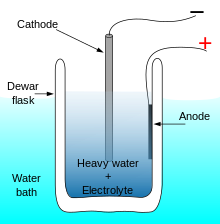
Here is a simple example of the lab setup for electrolysis:
image:  simple example of the lab setup for electrolysis


The media flocked to the prospect of a cheap source of energy that didn't require depletable products.  But most physicists were skeptical, especially of any reaction that produced more energy than what was put in.  The reported results could not be reproduced by other labs; and eventually Pons and Fleischmann were discredited.  However, some groups continued to experiment, particularly the U.S. Navy and New Hydrogen Energy Institute in Japan.

Here is an image of the setup used by the researchers in Japan:

image: cold fusion setup used by New Hydrogen Energy Institute in Japan

The Wikipedia article further states:
After 1991, cold fusion research continued in relative obscurity, conducted by groups that had increasing difficulty securing public funding and keeping programs open. Research continues today in a few specific venues, but the wider scientific community has generally marginalized the research being done and researchers have had difficulty publishing in mainstream journals.
The Japanese group has discontinued work on cold fusion, but the groups that have continued have renamed their efforts to avoid the negative reactions of the scientific community to the term cold fusion.  The new nomenclature includes:
 ...Low Energy Nuclear Reactions (LENR) or Chemically Assisted Nuclear Reactions (CANR), also Lattice Assisted Nuclear Reactions (LANR), Condensed Matter Nuclear Science (CMNS) and Lattice Enabled Nuclear Reactions... --Wikipedia
The U.S. Navy has a library of papers on this topic at LENR-CANR.org.

What do you think -- is it the real thing this time?

-- Marge 


Friday, July 20, 2012

News from Second Life and some machinima

As a semi-retired citizen of Second Life (SL), the virtual world, I still watch the happenings there.  One of my main sources of news is the New World Notes (NWN) by Wagner James Au.

Second Life is an immersive experience and host to some of the finest, most eclectic artists I've seen.  Here are some photos of the build, Twomoons Island (no longer on the grid), where JAS store is located.  If you've never been to Second Life, you'll need to sign up (it's free), and download/install a viewer, to see this location in person.
***
image1 from Second Life, Twomoon Island

image2 from Second Life, Twomoon Island

image4 from Second Life, Twomoon Island

***

Machinima is very popular with Linden Lab, the creator and overlord of Second Life.  By definition machinima is produced by fans, and this is the case with SL as well.  And some of the works produced are indeed outstanding.

This first video was produced by Douglas Gayeton, whose site is called RumpleFarm; he's an accomplished multimedia director.  To see the back story, check out this article in NWN.
***
***

This second video was submitted as an entry by Nitwacket for a competition titled "Seek Wisdom," sponsored by the University of Western Australia (UWA).  To me, the video oddly exhilarating:
***
***

-- Marge

Monday, July 16, 2012

Ridley Scott's art


This post is essentially an homage to director Ridley Scott.  While I'm not much into being a fan, I felt it important to know more about how Mr. Scott works and what he's done after watching "Robin Hood" last night.  The movie "Robin Hood" didn't do well in theaters unfortunately.  But another of his pieces -- "Gladiator" -- did and is one of my all-time favorites as well.

Mr. Scott's attention to detail and his artistic vision are consistently eye-catching.  And he has a talent for tying into larger, cultural themes subtly. There's also a grittiness to the movie "Robin Hood" that adds to its charm.

Below Ridley Scott talks about
...how he’s found locations, envisioned scenes within them, and used drawings to build those scenes, Scott offers an insight into the look and feel of his own work and useful advice to fellow creators, whether or not they work in a visual medium... -- Open Culture, "Ridley Scott Demystifies the Art of Storyboarding (and How to Jumpstart Your Creative Project)  "
***
***

Oh, and in 1973 Mr. Scott directed a commercial for Hovis bread that you may enjoy. This version was published by The Ad Show. 
***

***

-- Marge


Thursday, July 12, 2012

Free 3D textures and tiling a texture

Today I started my post wanting to share a site that offers free 3D textures and wound up finding a for-pay application that makes lovely textures.  Let's take a look.

Why 3D textures, you may ask.  They're helpful for people who work with 3D applications such as Maya, 3DStudio, Daz3D Studio, SecondLife, OpenSim, and so on.  They're also useful if you want a repeating pattern that looks realistic in artwork, as a background in a photo, or for your desktop.  Here's a picture of a dome I built in Second Life to which I added a custom pattern.

Second Life, Alchemy Lab
CG Textures is the site that offer 3D textures, free for both personal and commercial use.  In the tutorials section you can find one on tiling complex patterns.   The tutorial is written for Adobe Photoshop; but, if you know Corel PhotoPaint, you can translate the instructions to that application.

While looking for a Corel how-to on tiling textures, I found this guy (Chris Pirillo) recommending Repper. (He has a text feed going at the bottom of his video image, LOL.)


Repper looked intriguing so I searched it out and found that it's no longer free, but costs €29 (≈$43) via PayPal.  It works on both Windows and MAC.  Here's the demo. 

Still not satisfied with my offering of how to tile patterns, I found one more tutorial -- this one for open source Inkscape.   While this tutorial is about cloning radial patterns, there are many other ways you can use Inkscape's cloning tool.
 
 
-- Marge

Wednesday, July 11, 2012

Virtual worlds: education, training and collaboration

As an explorer of virtual worlds, I like to keep up on what's happening.  Despite rumors that Second Life is dying and the metaverse has had its day, the number of virtual worlds is growing. Here's a list (2015) of the Top 10 Virtual Worlds.

Karl Kapp's post "3D Virtual Worlds are NOT Dead, Dying or Disappearing (Mar 2012)" agrees that the number of virtual worlds is growing.  In his post he discusses uses for virtual environments and lists some.  Writing about virtual worlds as suitable environments for work is Aliza Sherman at GigaOm in her article "Virtual Worlds: Immersive Training, Collaboration and Meetings (Jun 2011)".  She states:
Are virtual worlds really viable environments for work? According to a survey by Unisfair, a global provider of virtual events and business environments, usage of virtual environments is growing for marketing, training and collaboration. Surveying 550 marketers nationwide, the study revealed that 60 percent of respondents plan to increase spending on virtual events and environments this year.
The breakdown of virtual activities outlined in the survey include training (42 percent); customer engagement (36 percent); internal collaboration (34 percent); lead generation (29 percent); and networking (8 percent). Nearly half of the respondents predict an increase in “hybrid” corporate events within two years.
This article on IBM's developerWorks page talks about the company's use of Virtual Spaces to enable immersive, global collaboration.  In the summary it states that
Globalization and a challenging business environment are placing new demands on today's enterprises. Organizations that are in an increasingly distributed environment are striving to provide guidance and enablement for teams working across disparate time zones.
Other uses for virtual worlds include:
  • Immersive education, such as what is described at Media Grid, and
  • Health care training and eduction, such as CliniSpace.

Note: This post contains dated material.

-- Marge


Friday, July 06, 2012

Animated short films

It being Friday, I went looking for some humor.  I didn't find anything I wanted to use but these animated short films are well worth watching.  Some of them aren't that short, or even funny, but all of them are beautifully done.

Sintel (2010) - full cartoon by the Blender Foundation (HD 1080p) (14:48 mins) -- This looks like a trailer for a game to me.  Lovely artwork.


Love Recipe (5:12 mins) -- Amazing amount of detail


Alarm (8:50 mins) -- This animation by Mesai, a South Korean animation team, feels too long for the subject matter, but the animation techniques are done perfectly.  Just look at the dynamic cloth of the curtains.


Alma (5:25 mins) -- This is a little dark, but again, beautiful work.


Little Tombstone (5:12 mins) -- A robustly French animation, this is reminiscent of one of Clint Eastwood's spaghetti westerns. It's posted by the ESMA Movies channel.


T-t-that's all, Folks.

-- Marge

Thursday, July 05, 2012

Making a video with YouTube's Video Editor

The controls for this editor seem to me subtle and somewhat easily broken.  Be sure to put the title in first and don't change it after you've started editing or you'll lose your work. I restarted the project below 4 times (or more -- wah, wah, wah) due to errors being injected during the editing process.  (I swear I can break any piece of software you give me.)  It's also probably a good idea to select whether this is a "new project" or "my edited video."

Here's a breakdown of the controls:
  • To see a selection of video snippets and videos you can use, click (cc) in the title bar; for music, the musical notes; and for transitions between scenes, the facing triangles ( >< ).  The "a" allows you to make a text page.  To edit videos you've uploaded, click the camera icon.  The selections are drag-and-drop. 
  • Once you've placed the selected video in an empty square below the viewing area, you can adjust the length of the video by clicking on the bar at the top.  Two brackets will appear ( [] ) that can be moved at either end.  You can delete a video placed in the timeline using the small X at the right end of the top bar of the selected video.  The symbols that appear when you mouseover the selected video are self-explanatory.
  • Drag the music selected to the bottom placeholder.  Note the slider that selects original audio to favor music to music only, and that your audio selection applies to the whole music stream. There appears to be no way to control the length of the music selection.  I may have missed it.
  • The "Q" slider give finer detail on the timeline.  Not sure that it was particularly helpful.
  • Slide the red tab back and forth to start playback at a specific place in the timeline.  Click the play button is the viewing area to see what you have.
Once you click the publish button in the title bar, it goes into a processing mode that seems to take forever.  In fact it has been processing for more than half-an-hour.
 
The video I made from scratch using YouTube's Video Editor is entitled "City Trek."  The music is "Ball of Waxx" by Dratini; I saw no credits on the video samples.  Here it is --


-- Marge