Pages

Monday, June 15, 2015

Psych: romance and choice

image: rose with book
Breathless Books, Assent Publishing
***
It's likely you don't choose a romantic partner the same way you choose a car. True? Me, I go out into the world and whoever clicks, clicks. Most of the time I go home alone. Aaron Ben-Zeév, Ph.D., writing in Psychology Today says:
We have 3 common approaches, but 2 are fatally flawed.
His article also says:
One important aspect of choosing a romantic partner is the weight we give to bad (negative) and good (positive) qualities. Although we tend to focus more on the partner's bad qualities at the stage of choosing a partner, it seems that in the long run, positive qualities become more important and eventually outweigh the negatives.
Social psychology has an idea that relationships are based on rational choice and cost-benefit analyses. To quote Wikipedia:
If one partner's costs begin to outweigh his or her benefits, that person may leave the relationship, especially if there are good alternatives available.
For more on the Social Exchange Theory, take a look at these articles at Boundless and Psych-it.

This theory may be true near the end of the relationship, but (seems to me) at the beginning the choice is relatively irrational.  It happens that how and what we decide to buy has been the topic of intense study by those selling for some time now. Just google "Studying people’s buying habits." There's more about buying decisions at Buying decision process and Rational choice theory on Wikipedia. And, when we choose someone, aren't we really "buying" what they have to offer?

Again, I personally think romantic choices are irrational, because that's how I make them (then rue the day). There's an interesting article about irrational choices from Daniel McFadden's paper "The New Science of Pleasure," published by the Atlantic. In his paper he says:
...The popular psychological theory of "hyperbolic discounting" says people don't properly evaluate rewards over time. The theory seeks to explain why many groups -- nappers, procrastinators, Congress -- take rewards now and pain later, over and over again. But neurology suggests that it hardly makes sense to speak of "the brain," in the singular, because it's two very different parts of the brain that process choices for now and later. The choice to delay gratification is mostly processed in the frontal system. But studies show that the choice to do something immediately gratifying is processed in a different system, the limbic system, which is more viscerally connected to our behavior, our "reward pathways," and our feelings of pain and pleasure.
How do you choose?

-- Marge


Friday, June 12, 2015

Cartoons: cyber doomsday

If you're one of the estimated 14 million current or former civilian U.S. government employees, the hackers who recently broke into the US Office of Personnel Management (OPM) now know all about you (and me). But don't feel alone--security firm Kaspersky Labs got hacked too.

And don't expect any of the security holes to be plugged soon, because Congress is at war on the issue of cyber security. Here's a blow-by-blow description of the most recent battle.
***
image: cartoon by Nate Beeler
Nate Beeler, The Week
***

U.S. cyber security is handled by the Department of Homeland Security, the same agency that manages the TSA.
***
image: cartoon by John Darkow
John Darkow, The Week
***
image: cartoon by Drew Sheneman
Drew Sheneman, The Week
***

All in all, the front has definitely changed.
***
image: cartoon by Steve Breen
Steve Breen, The Week
***

-- Marge


Wednesday, June 10, 2015

DIY: framing canvas panels

image: canvas panels and a variety of other artist's panels
Canvas (and other) panels, Life of a Daily Painter
***
Usually I paint on canvas stretched over a wooden frame. But the materials can be expensive and the frames don't always come out true, that is square and flat (a good topic for another post by the way). Because I'm branching out into faux encaustic, recently I purchased several small 8 by 10 and 11 by 14 inch canvas panels for experimentation.

With artwork, even experiments can turn out good--and then you have to figure out how to present them. Present mostly means hanging the piece on a wall in a fairly attractive manner. Jon Peters talks about presentation in this video.
***

*** 


The problem with Jon Peters' method is that he uses power tools. My use of power tools includes a drill, a sander, and a small router. So if you want to make a frame and don't have circular saw or don't want to use one (I tend to be somewhat accident-prone, which could spell disaster); try using a hand miter box for the frame corners. Here's an article on how to properly use a miter hand saw.

My original idea for mounting the panel was to route a straight channel for the panel to fit in. Jon uses a routed rabbet in the demonstration above, another solution. Or, you could use a 1 by 1 furring strip glued inside the outer frame for the panel to rest on.
***
image: router bit types and associated cuts
Router bit types and associated cuts, PMC
***

This floating panel idea by Jon Peters really appeals to me, although half-inch plywood seems a little thick. Note that you still have to make the frame with a ledge for the panel with backing to sit on. Also note how the inside of the frame is finished matte black.
***
***

Here's a step-by-step article on custom framing using no power tools by A Beautiful Mess. And here's another article about making float frames that shows different clamps used for artwork frames. The Grizzly clamp looks particularly useful.

-- Marge


Monday, June 08, 2015

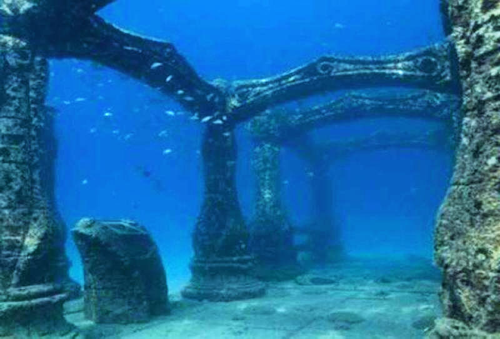
Cities lost to the sea

Cities captured by the waves and drawn to a watery death captivate the imagination. Where once people bustled about their daily tasks, reclined at their leisure, and gathered to share the daily news, now fishes feed and sand sifts over their remains.

There are a number of cities that have been claimed by the sea; one is Heracleion, also known as Thonis, near what was once Alexandria.
***
image: Underwater statue of a pharaoh
Statue of a pharaoh (©Franck Goddio/Hilti Foundation, photo: Christoph Gerigk), Collective Evolution
***

Seventeenth-century Port Royal, a city of pirates, was known as the "wickedest city on earth." It was featured as a "location within Disney's Pirates of the Caribbean film series, though much of the location work for Port Royal was actually done on the island of Saint Vincent, not in Jamaica. (Wikipedia)"
***
image: Port Royal, Jamaica, underwater
Port Royal, Jamaica, Earth Porm
***

Four more cities are listed by Earth Porm: The Pyramids of Yonaguni-Jima, Japan; Dwarka, Gulf of Cambay, India; Lion City of Quiandao Lake, China; and Cleopatra’s Palace, Alexandria, Egypt.

Andrew Handley has an article about lesser known mysterious underwater cities. The image below shows pottery found at Mulifanua, a tiny village perched on the northernmost tip of Upolu in the Samoan archipelago. This pottery dates back to about 800 B.C.
***
image: remains from a Lapita village
Andrew Handley, Mulifanua Bay, Listverse
***

-- Marge


Friday, June 05, 2015

Cartoons: smoke and mirrors

Under the Patriot Act the NSA gathers too much data, much of it using phone company and social media records. This week Congress partially renewed the Patriot Act with passage of the Freedom Act. As a side note, China hacked the federal Office of Personnel Management. Looks to me like privacy is an illusion.
***
image: cartoon by Drew Sheneman
Drew Sheneman, The Week
***

Meanwhile, Edward Snowden spoke out in the Washington Post.
***
image: cartoon by Pat Bagley
Pat Bagley, The Week
***

The TSA has been found to be 95% ineffective. According to the Washington Post,
This week, the acting head of the Transportation Security Administration got bounced from his job because in 95 percent of test cases, real guns or fake bombs made it past the TSA.
***
image: cartoon by Steve Sack
Steve Sack, The Week
***

Because of the extended drought in California, the largest desalination plant in the Western Hemisphere is being brought online. Hopefully this cartoon will prove to be a false prediction.
***
image: cartoon by Steve Breen
Steve Breen, The Week
***

-- Marge


Wednesday, June 03, 2015

DIY: patterns and knots

image: photo by Sailko of 10th Century dish from East Persia
10th Century dish, EastPersia (photo by Sailko), Wikipedia
***
This post started as a guide for drawing Celtic knots. It has expanded to knot designs and patterns in various cultures and some intriguing information about the use of needles by Neanderthals 50,000 to 100,000 years ago.

First, the Celtic knots. Some call it plaiting, a term usually applied to braiding hair. This little example is shown on the blog Celtic Sprite.
***
image: diagram of Celtic knot design from entrelacs.net
CelticKnotwork: TheUltimateTutorial, Branawen
***

There are many tutorials online for Celtic and other patterns, such as Making Celtic Knots (dots method); How to draw Celtic knots; and How to design Celtic Knot Patterns by Creative Doodling. For a general discussion of patterns in art, take a look at Quick Tips in Art & Design: Pattern.

Celtic knots are not just Celtic, many cultures use interlaced patterns in their artwork, especially the Islamic. And there is Chinese knotting, which can be duplicated in macramé. Here's a sample Islamic pattern.
***
image: a sample of Islamic Art from Wade Photo Archive
Pattern in Islamic Art, Wade Photo Archive
***

Knowing that these repeat patterns cross cultures, I tried to find an article that discusses this.  Instead I found that man's use of needles goes back 100,000 years:
Archaeological studies indicate that the art of tying knots dates back to prehistoric times. Recent discoveries include 100,000-year old bone needles used for sewing and bodkins, which were used to untie knots. (Wikipedia)

Further, Neanderthals may have taught modern humans how to make needles:
Bone tools have been discovered in the context of Neanderthal groups as well as throughout the development of modern humans. Archaeologists have long believed that Neanderthals learned how to make bone tools from modern humans and by mimicking stone tools, viewing bone as simply another raw material. Modern humans, on the other hand, took advantage of the properties of bone and worked them into specific shapes and tools.
A recent discovery of specialized bone tools at two Neanderthal sites in southwestern France brings to light the idea that Neanderthals may have actually taught modern humans how to make specialized bone tools. The uncovering of lissoirs (“polishing stones”) at these sites is significant as they are about 51,000 years old, predating the known arrival of modern humans to Europe. (Wikipedia: Bone Tool)

In researching this topic I stumbled across World Myths in Legend & Art. Worth exploring.

-- Marge

Monday, June 01, 2015

Fabled Atlantis, lost continent

image: Bimini Island from space, NASA
NASA, Bimini Island, Wikipedia
***
The lost continent of Atlantis has captured imaginations for centuries. What confuses the issue of whether it really exists and where are the known accounts of it. Plato, writing around 360 BC in Timaeus (dialogue), says
For it is related in our records how once upon a time your State stayed the course of a mighty host, which, starting from a distant point in the Atlantic ocean, was insolently advancing to attack the whole of Europe, and Asia to boot. For the ocean there was at that time navigable; for in front of the mouth which you Greeks call, as you say, 'the pillars of Heracles,' there lay an island which was larger than Libya and Asia together; and it was possible for the travelers of that time to cross from it to the other islands, and from the islands to the whole of the continent over against them which encompasses that veritable ocean. For all that we have here, lying within the mouth of which we speak, is evidently a haven having a narrow entrance; but that yonder is a real ocean, and the land surrounding it may most rightly be called, in the fullest and truest sense, a continent. Now in this island of Atlantis there existed a confederation of kings, of great and marvelous power, which held sway over all the island, and over many other islands also and parts of the continent. (Wikipedia)
Pillars of Hercules is the ancient name for the Straits of Gibralter.

Among the several problems with researching Atlantis are the varying interpretations of its location and that its fabled powers are fare for conspiracy theories and metaphysics alike. Discovery of Atlantis theorizes that ancient Atlantis is located in the Mediterranean between the island of Cyprus and the eastern mainland. It was my readings on Edgar Cayce that introduced me to the mysteries of Atlantis and I must admit I'm partial to his information and interpretations.

About the only (possibly) solid evidence of an Atlantean civilization we have is Bimini Road, a series of rocks that appear to be dressed stone arranged like a road or wall. There is little agreement on whether the stones are worked or natural. And dating them has proved problematic.

Venturing off into the unprovable (at least, so far) here's a replay from the History Channel's speculative series "In Search of..." This episode is one of three about Atlantis near Bimini.
***
***

For a while it looked like evidence of Atlantis had been found on Google Earth. But new information from NOAA has erased it (it was due to an overlap of datasets anyway).
***
***

-- Marge


Friday, May 29, 2015

Cartoons: How the tune changes

Time passes, things happen and the tune changes. Then it changes again. As the philosophers say: the only constant is change.
***
image: cartoon by Mike Luckovich
Mike Luckovich, The Week
***

Last year it was the 'pollen vortex', this year it's the 'pollen tsunami'. Call it what you will pollen counts have been rising yearly. or so the reporters say (unable to find numbers to support that). GlobalChange.gov has a good graph on observed CO2  emissions vs. Temperature.
***
image: cartoon by Tom Toles
Tom Toles, The Week

***


Last week it was Deflategate, this week it's FIFA corruption charges.
***
image: cartoon by Bob Gorrell
Bob Gorrell, The Week

***


This cartoon is, for me, self-evident.
***
image: cartoon by Steve Kelley
Steve Kelley, The Week

***


-- Marge


Wednesday, May 27, 2015

DIY DIWhy

Here are some DIY projects that went wrong or just don't work. You'll see why.

Viralnova coined the term DIWhy. Here's a link to their about page and a sample from Forget DIYs, These Are 2014's 20 Best DI-'Why?' Projects.
***
image: photo of furry fridge
Furry Fridge (Imgur via Reddit), ViralNova
***

The venerable Popular Mechanics has this article: There, I Fixed It: 10 Hilariously Bad Home DIY Projects.
***
image: temporary repair, West Virginia State Dept of Transportation gas station
West Virginia State Dept of Transportation gas station, Popular Mechanics
***

Then there's the world that postgrads live in. This is from When DIY Goes Wrong…Or Right (24 Photos).
***
image: photo of couch fix
Couch Fixed, Post Grad Problems
***

-- Marge


Friday, May 22, 2015

Cartoons: Bankers and Letterman

The cartoons this week are overwhelmingly about Hillary and Jeb, the Middle East and ISIS, and college debt; here are three that aren't.

With chickens and their eggs cage-free is good; with bankers not so much. And to think I store my modest funds in one.
***
image: cartoon by Mike Luckovich
Mike Luckovich, The Week
***

Another example of the Congress' and the GOP's mixed messages, to say the least.
***
image: cartoon by Pat Bagley
Pat Bagley, The Week
***

Letterman has left the Late Show, but his Stupid Pet Tricks live on--check YouTube. Here's a tricky word play for you.
***
image: cartoon by Walt Handelsman
Walt Handelsman, The Week
***

-- Marge


Wednesday, May 20, 2015

DIY: open up your world

image: kids laughing together
Kids, Cincinnati Enquirer
***
With so much prejudice, even hate, filling the news now, isn't it time to step back and decide what you want your world to look like and be? An all-white or all-black or all-brown world is NOT a viable solution. Such a solution would entail either shutting yourself off from the majority of humanity in a strongly gated, highly exclusive community or mass genocide. Seems to me the better answer is to teach yourself how to deal with diversity.

To exercise prejudice may be hardwired into humans, as Morgan Freeman points out in the video below--it's a my tribe vs. your tribe mindset. Seems to me it's time for us to outgrow the tribal mindset. As Akhenaten (Egyptian Pharaoh (-1354 BC) said:
True wisdom is less presuming than folly. The wise man doubts often, and changes his mind; the fool is obstinate, and doubts not; he knows all things but his own ignorance.

The video (granted, the study is of mice) here shows that simply associating with someone different opens the door to empathy and ultimately a world with more tolerance.
***
***

The study referred to in the video is reported in Rodent empathy is environmental and not genetic by the Washington Post. The study itself is available at eLife.

Cindy Krantz in the Cincinnati Enquirer wrote in 2000 about Preparing kids for a multicultural world. In her article she breaks down the demographics then. For an analysis of demographics in the U.S. in 2015, check out the Wikipedia article.
***
image: graph of U.S. demographics in 1990
U.S. demographics in 1990, Cincinnati Enquirer
***

Kids in kindergarten mingle happily with other cultures. Then the prejudices of their parents take over. We can change that.

Stepping down from my soapbox now.

-- Marge


Monday, May 18, 2015

Science: the flux we live in

image: illustration using SGR 1745-525
Magnetar SGR 1745-525, NASA-Chandra

***
On May 16th NASA issued a press release reporting that a magnetar near a supermassive black hole delivers surprises. The black hole is the one at the center of the Milky Way; the surprise is that
the amount of X-rays from SGR 1745-2900 is dropping more slowly than other previously observed magnetars, and its surface is hotter than expected.
My interest was piqued. On researching the literature about Magnetars, I found this
1979 discovery
On March 5, 1979, a few months after the successful dropping of satellites into the atmosphere of Venus, the two Soviet spacecraft that were then drifting through the Solar System were hit by a blast of gamma radiation at approximately 10:51 EST. This contact raised the radiation readings on both the probes from a normal 100 counts per second to over 200,000 counts a second, in only a fraction of a millisecond.
This burst of gamma rays quickly continued to spread. Eleven seconds later, Helios 2, a NASA probe, which was in orbit around the Sun, was saturated by the blast of radiation. It soon hit Venus, and the Pioneer Venus Orbiter's detectors were overcome by the wave. Seconds later, Earth received the wave of radiation, where the powerful output of gamma rays inundated the detectors of three U.S. Department of Defense Vela satellites, the Soviet Prognoz 7 satellite, and the Einstein Observatory. Just before the wave exited the Solar System, the blast also hit the International Sun-Earth Explorer. This extremely powerful blast of gamma radiation constituted the strongest wave of extra-solar gamma rays ever detected; it was over 100 times more intense than any known previous extra-solar burst. Because gamma rays travel at the speed of light and the time of the pulse was recorded by several distant spacecraft as well as on Earth, the source of the gamma radiation could be calculated to an accuracy of about 2 arcseconds. The direction of the source corresponded with the remnants of a star that had gone supernova around 3000 B.C.E. It was in the Large Magellanic Cloud and the source was named SGR 0525-66, the event itself was named GRB 790305b, the first observed SGR megaflare.
From another section of the Wikipedia article we learn that "magnetars are around 20 kilometres (12 mi) in diameter and have a greater mass than the Sun." Despite this minute size in comparison to other celestial bodies, the burst of radiation raised the radiation reading from the normal 100 count per second to over 200,000 counts per second in a timeframe of milliseconds when detected by the Soviet probes. None of the radiation is reported to have been detected within Earth's atmosphere.

This is a tale of only one magnetar event. "As of November 2013, 21 magnetars are known, with five more candidates awaiting confirmation." reports Wikipedia.

What I wonder is how is life on Earth would be affected if such radiation penetrated Earth's atmosphere. The wave passed through the solar system at the speed of light, too fast for our bodies to detect and react. But the brain works with electricity, which is in the same realm as solar and other radiation. This EPA page gives a good summary of types of radiation.

If magnetar and similar radiation events affect our brains, how? Mentally? Emotionally? An image that comes to mind is the event following contact with the monolith in 2001: A Space Odyssey: an ape's discovery of using a tool. Don't get me wrong, I'm not saying we should walk around wearing tin-foil helmets, but I am asking if historical and social events are sometimes triggered by the celestial flux we live in.
***
image: screenshot from 2001: A Space Odyssey
Discovery, 2001: A Space Odyssey
***

-- Marge


Friday, May 15, 2015

Cartoons: sellouts and those clueless

Sometimes we sellout to gain money or security or even love; sometimes we don't know we're selling out 'til it's over. Here are some examples.

Picasso didn't sellout, but the art world has. The latest price is $179 million dollars.
***
image: cartoon by Steve Breen
Steve Breen, The Week
***

It's beginning to look like the Democratic Party is putting all of it's eggs in one basket--Hillary. Is this a sellout or are they just clueless?
***
image: cartoon by Michael Ramirez
Michael Ramirez, The Week
***

At the risk of offending my religious readers, my view of religion is that it has for centuries sold out our spirituality. There I said it.
***
image: cartoon by Mike Luckovich
Mike Luckovich, The Week
***

Drone warfare is still war. Has war been declared? No, but the U.S. Congress approves of the drone strikes.
***
image: cartoon by Bill Day
Bill Day, The Week
***

-- Marge


Wednesday, May 13, 2015

DIY: sewing your own fashion

image: Vogue pattern 8806
Vogue pattern 8806, Sewing Patterns
***
Sewing can be one of the most exasperating endeavors I've encountered--can't tell you how many times I've had to re-do what I just did because I did it backward. That said, in today's retail clothing market, sometimes sewing a garment yourself is about the only way you can find/afford something unique.
***
image: Burda pattern 8108
Burda pattern 8108, Sewing Patterns
***

Probably the single most common error I make when putting together a sewing project is selecting an inappropriate fabric or print to go with the pattern.  It's best to look at the garment illustration on the pattern envelope carefully and heed the fabric suggestions on the back, unless you have a very clear idea of the look you want to create. Sewing Patterns has a good selection of patterns.

If you're new to sewing, there's a lot to learn. Getting to the stage where you can put together a Vogue Couture pattern may take years. There is a Very Easy Vogue collection that has many desirable designs and suits beginners' skills, such as the one below. While it's always best to buy the size that fits your measurements, in my experience Simplicity and McCalls patterns feel small for the measurements given.
***
image: Very Easy Vogue pattern 9115
Very Easy Vogue pattern 9115, Sewing Patterns
***

A good guide is essential; one that I've used so much it's falling apart is Simplicity Sewing Book (This links to a revised version at Amazon).

For me, one of the most pleasurable aspects of sewing is shopping for and handling fabrics. There are excellent deals and large selections online (Online Fabric Store slider), but you really should go to a local fabric store to get a sense of how light or heavy, firm or not firm, stiff or pliable--called the hand--a fabric is.

If you really don't want to open this can of worms, fulfilling as it can be, and would rather let someone else do the handiwork, take a look at sites like Etsy Clothing, ArtFire, and Rebels Market. There's a list of Etsy alternatives at Business News Daily.

-- Marge


Monday, May 11, 2015

Politics and polls: boycotting the election

This idea behind a cartoon posted Friday has been haunting me.
***
image: cartoon by Gary Varvel
Gary Varvel, The Week
***

What if, because of the current state of elections--influence by big money and mind-searing partisanship, people decide that the elections are just not worth their time. Or what if the more pro-active, but democratically debilitating phenomenon takes place and people as a group make their intention to boycott the election known?

According to one reference, the Pew Research Center, there is now a Party of Nonvoters, consisting of "younger, more racially diverse, more financially strapped" people. With the increasing gap between the monied 1% and and the rest of us, the ranks of the financially strapped is likely to increase. Pew Research further defines Who Votes, Who Doesn’t, and Why in an article published in 2006. In 2008, when Obama was first elected, CNN reported Number of votes cast set record, but voter turnout percentage didn't. Wikipedia shows that voter turnout in 2008 was "57.5 percent of the eligible voters."

If you look at the polls at Real Clear Politics, the numbers are kind of overwhelming. Being informed in these times can be a fulltime job. For another view of the issues, take a look at I Side With's list of political issues of 2015.

The idea in a democracy is to have your say via one vote. What that one vote says in this political atmosphere is questionable. And sullying the election process with vast amounts of money only makes things worse. In fact throwing money at the election process in an attempt to entice disenfranchised voters to vote seems pretty ineffective.

I found a few voices calling for boycotts of U.S elections. One voice is Election Boycott Advocates. Their byline is "Reject capitalism, demand democracy." Unfortunately the site has strong socialistic overtones. However, this point by the author resonated with me:
Laws restricting third party participation, an elections system that favors money over votes, a two-party system that has no room for any other than the official liberal and conservative ideologies, a Supreme Court that protects the right of billionaires to buy elections and politicians. Why bother, the majority of Americans ask as they throw their hands up in exasperation with a system that just doesn't work for them.
If you search on 'boycott elections' you'll find that a number of countries have done so. Mehrunisa Qayyum at Huffington Post surveys the effectiveness of some boycotts. (Remember, this is an opinion piece.) One boycott in India is particularly interesting, Village sans hospital to boycott polls. The article quotes a village spokesperson,
Leaders have been coming to us but we decided not to vote for any of them this time. It is high time now not to vote. They only give fake promises --Panja Singh, 62, a resident of Jhangola village

-- Marge


Friday, May 08, 2015

Cartoons: going for the humor

Looks to me like cartoonists are getting as snarky as the politicians and news reporters at Fox.  So today's mix is an attempt to find the humor in it all.

Ben Carson, a Tea Party candidate for president in 2016, is not particularly popular with voters, according to poll results at I Side With... Tom Toll's cartoon below paraphrases Ben Carson's statement, quoted from the Huffington Post, "that being gay was a choice "because a lot of people who go into prison go into prison straight -- and when they come out, they're gay. So, did something happen while they were in there? Ask yourself that question." The paraphase makes much more sense to me.
***
image: cartoon by Tom Toles
Tom Toles, The Week
***

Republican's denial of climate change has made them a laughingstock to many. I Side With asks "Should the government increase environmental regulations to prevent global warming?" You can check the poll answers.
***
image: cartoon by Mike Luckovich
Mike Luckovich, The Week
***

I hope Chris Christie is unable to overcome Bridgegate--in my eyes, it says clearly what his values and methods are. We're still allowed to laugh, though.
***
image: cartoon by Walt Handelsman
Walt Handelsman, The Week
***

Unfortunately this cartoon may be too true in depicting what will happen in November 2016, if the political scene continues to unravel.
***
image: cartoon by Gary Varvel
Gary Varvel, The Week
***

-- Marge