
In 1989, a research team at the University of Utah reported that they had produced unexplained excess energy during their electrolysis research. The Wikipedia article on cold fusion describes their results thus:

The media flocked to the prospect of a cheap source of energy that didn't require depletable products. But most physicists were skeptical, especially of any reaction that produced more energy than what was put in. The reported results could not be reproduced by other labs; and eventually Pons and Fleischmann were discredited. However, some groups continued to experiment, particularly the U.S. Navy and New Hydrogen Energy Institute in Japan.
Here is an image of the setup used by the researchers in Japan:

The Wikipedia article further states:
Stanley Pons and Martin Fleischmann, then one of the world's leading electrochemists, [reported] that their apparatus had produced anomalous heat ("excess heat"), of a magnitude they asserted would defy explanation except in terms of nuclear processes. They further reported measuring small amounts of nuclear reaction byproducts, including including neutrons and tritium. The small tabletop experiment involved electrolysis of heavy water on the surface of a palladium (Pd) electrode..Here is a simple example of the lab setup for electrolysis:
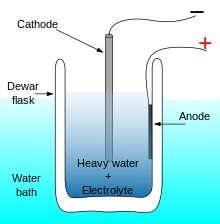
The media flocked to the prospect of a cheap source of energy that didn't require depletable products. But most physicists were skeptical, especially of any reaction that produced more energy than what was put in. The reported results could not be reproduced by other labs; and eventually Pons and Fleischmann were discredited. However, some groups continued to experiment, particularly the U.S. Navy and New Hydrogen Energy Institute in Japan.
Here is an image of the setup used by the researchers in Japan:

The Wikipedia article further states:
After 1991, cold fusion research continued in relative obscurity, conducted by groups that had increasing difficulty securing public funding and keeping programs open. Research continues today in a few specific venues, but the wider scientific community has generally marginalized the research being done and researchers have had difficulty publishing in mainstream journals.The Japanese group has discontinued work on cold fusion, but the groups that have continued have renamed their efforts to avoid the negative reactions of the scientific community to the term cold fusion. The new nomenclature includes:
...Low Energy Nuclear Reactions (LENR) or Chemically Assisted Nuclear Reactions (CANR), also Lattice Assisted Nuclear Reactions (LANR), Condensed Matter Nuclear Science (CMNS) and Lattice Enabled Nuclear Reactions... --WikipediaThe U.S. Navy has a library of papers on this topic at LENR-CANR.org.
What do you think -- is it the real thing this time?
-- Marge

