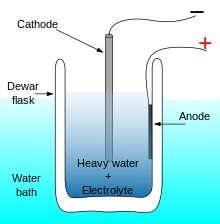
After a survey of what's happening with photovoltaic power stations and grid energy storage (you can find a list of large-scale photovoltaic power plants currently in operation at the Sun Energy site), I ended up back at cold fusion, the black box.
According to an article at Phys.org (March, 2009), there may be a "'Cold fusion rebirth." Quoting the article:
***
For reference three sites offer current information: Cold Fusion Times, Cold Fusion Now, and LENR - Cold Fusion. There's also an interesting article at ExtremeTech (a number of comments say too good to be true).
-- Marge
While still as unpopular as ever, the topic has acquired some new variants, such as muon-catalyzed fusion which, according to Wikipedia is "is well established, real, and repeatable." Also, there's pyroelectric fusion and a polywell.
***
***
 |
| Polywell WB-6 model assembled, Wikipedia |
One of the problems with cold fusion was the inability of independent labs to repeat the original experiment, as the Wikipedia article on cold fusion states:
However the U.S. Navy persisted with its own work, zeroing in on the low-energy nuclear reaction (LENR) and chemically-assisted nuclear reaction (CANR) aspects of cold fusion.Many scientists tried to replicate the experiment with the few details available. Hopes fell with the large number of negative replications, the withdrawal of many positive replications, the discovery of flaws and sources of experimental error in the original experiment, and finally the discovery that Fleischmann and Pons had not actually detected nuclear reaction byproducts.
According to an article at Phys.org (March, 2009), there may be a "'Cold fusion rebirth." Quoting the article:
Researchers are reporting compelling new scientific evidence for the existence of low-energy nuclear reactions (LENR), the process once called "cold fusion" that may promise a new source of energy. One group of scientists, for instance, describes what it terms the first clear visual evidence that LENR devices can produce neutrons, subatomic particles that scientists view as tell-tale signs that nuclear reactions are occurring.***
 |
| An experimental "cold fusion" device produced this pattern of "triple tracks" (shown at right), which scientists say is caused by high-energy nuclear particles resulting from a nuclear reaction Credit: Pam Boss, Space and Naval Warfare Systems Center (SPAWAR), phys.org |
For reference three sites offer current information: Cold Fusion Times, Cold Fusion Now, and LENR - Cold Fusion. There's also an interesting article at ExtremeTech (a number of comments say too good to be true).
-- Marge