Today's cartoons look at the Iran nuclear deal, the Pluto flyby, U.S. cybersecurity, Operation Jade Helm 15, and Jeb vs. Trump.
For some opinions voiced by regular folks on the Iran nuclear deal, check out these letters to the editor at the New York Times. As for Republicans, their opinions don't change.
U.S. cybersecurity may take another hit, this time by some regulations proposed by the Commerce Department. A Coalition for Responsible Cybersecurity has been formed to prevent it. Time for us to speak out--again.
the amount of X-rays from SGR 1745-2900 is dropping more slowly than other previously observed magnetars, and its surface is hotter than expected.
My interest was piqued. On researching the literature about Magnetars, I found this
1979 discovery On March 5, 1979, a few months after the successful dropping of satellites into the atmosphere of Venus, the two Soviet spacecraft that were then drifting through the Solar System were hit by a blast of gamma radiation at approximately 10:51 EST. This contact raised the radiation readings on both the probes from a normal 100 counts per second to over 200,000 counts a second, in only a fraction of a millisecond.
This burst of gamma rays quickly continued to spread. Eleven seconds later, Helios 2, a NASA probe, which was in orbit around the Sun, was saturated by the blast of radiation. It soon hit Venus, and the Pioneer Venus Orbiter's detectors were overcome by the wave. Seconds later, Earth received the wave of radiation, where the powerful output of gamma rays inundated the detectors of three U.S. Department of Defense Vela satellites, the Soviet Prognoz 7 satellite, and the Einstein Observatory. Just before the wave exited the Solar System, the blast also hit the International Sun-Earth Explorer. This extremely powerful blast of gamma radiation constituted the strongest wave of extra-solar gamma rays ever detected; it was over 100 times more intense than any known previous extra-solar burst. Because gamma rays travel at the speed of light and the time of the pulse was recorded by several distant spacecraft as well as on Earth, the source of the gamma radiation could be calculated to an accuracy of about 2 arcseconds. The direction of the source corresponded with the remnants of a star that had gone supernova around 3000 B.C.E. It was in the Large Magellanic Cloud and the source was named SGR 0525-66, the event itself was named GRB 790305b, the first observed SGR megaflare.
From another section of the Wikipedia article we learn that "magnetars are around 20 kilometres (12 mi) in diameter and have a greater mass than the Sun." Despite this minute size in comparison to other celestial bodies, the burst of radiation raised the radiation reading from the normal 100 count per second to over 200,000 counts per second in a timeframe of milliseconds when detected by the Soviet probes. None of the radiation is reported to have been detected within Earth's atmosphere.
What I wonder is how is life on Earth would be affected if such radiation penetrated Earth's atmosphere. The wave passed through the solar system at the speed of light, too fast for our bodies to detect and react. But the brain works with electricity, which is in the same realm as solar and other radiation. This EPA page gives a good summary of types of radiation.
If magnetar and similar radiation events affect our brains, how? Mentally? Emotionally? An image that comes to mind is the event following contact with the monolith in 2001: A Space Odyssey: an ape's discovery of using a tool. Don't get me wrong, I'm not saying we should walk around wearing tin-foil helmets, but I am asking if historical and social events are sometimes triggered by the celestial flux we live in.
Are space and time (aka spacetime) a continuum? Einstein thought so, Petr Hořava, a physicist at the University of California, Berkeley, does not. Quoting from the article, Splitting Time from Space, in Scientific American:
Physicists have struggled to marry quantum mechanics with gravity for decades. In contrast, the other forces of nature have obediently fallen into line. For instance, the electromagnetic force can be described quantum-mechanically by the motion of photons. Try and work out the gravitational force between two objects in terms of a quantum graviton, however, and you quickly run into trouble—the answer to every calculation is infinity. But now Petr Hořava, a physicist at the University of California, Berkeley, thinks he understands the problem. It’s all, he says, a matter of time.
More specifically, the problem is the way that time is tied up with space in Einstein’s theory of gravity: general relativity. Einstein famously overturned the Newtonian notion that time is absolute—steadily ticking away in the background. Instead he argued that time is another dimension, woven together with space to form a malleable fabric that is distorted by matter. The snag is that in quantum mechanics, time retains its Newtonian aloofness, providing the stage against which matter dances but never being affected by its presence. These two conceptions of time don’t gel.
Evidence for Hořava's theory is offered in this followup.
So why are we including gravity in a discussion of spacetime? This article at Einstein Online explains Einstein's geometric gravity.
The Earth and everything on it is a source of electromagnetic radiation. The major fraction of this radiation is in the infrared part of the spectrum, whereas the incident solar radiation is primarily in the visible part of the electromagnetic spectrum.
For current information on solar activity, give SolarHam a look.
Another source for information on what the sun's currently up to, especially its cyclic activity, is The Old Farmer's Almanac.
In Alaska there's the Geophysical Institute at University of Alaska Fairbanks sensing how the solar wind affects Earth’s ionosphere and magnetosphere and sharing the data it collects. Another project, called HAARp (High Frequency Active Auroral Research Program), also offered some interesting data, but it has been shut down due to local distrust. It also became the target of a conspiracy theory, although some say the perceived threat was real.
Often electromagnetic radiation is referred to as a spectrum. Here's an excellent, but very long, NASA video giving a tour of the spectrum:
Star Trek's food replicator may be closer than you think. NASA even now is printing pizza, as reported in theGuardian and other news sources. Replication of mechanical parts is already a reality.
For those of you who are not Trekkies (or more casual fans of Star Trek), the food replicators (not to be confused with the Stargate replicators) in the series could produce verbally requested items on demand. As with most technology, one has to be specific: ****
***
While NASA has its eye on food replication, U.S manufacturing is being transformed. In a form of pedal-to-the-metal 3D printing, layers of metal are deposited and bound to a form built up from a design programmed into the printer. This process is revolutionizing American industry; as the NewScientist puts it "A Second Industrial Revoluton is Underway." More to the point is this a piece from Time Magazine (requires a paid subscription), "Made in the USA."
The technology is called additive manufacturing, or more colloquially, 3-D printing. When most people talk about 3-D printing, they mean fun devices for hobbyists that can print plastic toys and other small objects when hooked up to a computer. When they talk about it at ExOne Corp., they're describing something a lot bigger. Additive manufacturing involves what looks like spray-painting a metal object into existence. These 3-D printers lay down a very thin layer of stainless-steel powder or ceramic powder and fuse it with a liquid binder until a part--like a torque converter, heat exchanger or propeller blade--is built, layer by layer. ExOne's employees are ramping up production lines to make 3-D printers at a price of about $400,000. Would-be manufacturing entrepreneurs can buy the devices and begin turning out high-tech metal parts for aerospace, automotive and other industries at lower cost and higher quality faster than offshore suppliers.
Look around the ExOne site to get an idea of the capabilities of this field.
The article from Time also offers a vision of manufacturing in the future:
ExOne's 3-D-printing machines, like a lot of new technology, will displace some labor. A foundry, for instance, no longer needs workers carting patterns around a warehouse; it can print molds and cores stored on a thumb drive, and no patterns are needed. An ExOne shop with 12 metal-printing machines needs only two employees per shift, supported by a design engineer--though they are higher-skilled workers. Rockwell [ExOne's CEO] envisions a thousand new industrial flowers blooming. "There's a world of guys out there who say, If you can deliver parts in six or seven days, hey, I don't need the machines. That's where job creation is going to come from." Overseas competitors will not be able to deliver that quickly or at the same level of quality.
Seems to me it's got to be good if it get American employers off the offshore outsourcing teet.
In recent history engineering colleges around the world have sponsored robot competitions, often where robots battle each other and the last robot standing wins. Now ordinary citizens, and their robots, can take part in one (not necessarily a fight to the death). Here's a list of competitions from NASA's, Robotics Alliance Project, last updated today. IEEE (Institute of Electrical and Electronics Engineers, read I-Triple-E) Spectrum has a page reporting DIY robots news.
Kits and parts are available for purchase in building your own robot. A sampling of retailers is dfRobot, "drive the future;" Machine Science Inc., which offers parts and tutotials for all types of electronics projects; and, of course LEGO. Just take a look at LEGO's latest product, Mindstorms EV3.
In 1989, a research team at the University of Utah reported that they had produced unexplained excess energy during their electrolysis research. The Wikipedia article on cold fusion describes their results thus:
Stanley Pons and Martin Fleischmann, then one of the world's leading electrochemists, [reported] that their apparatus had produced anomalous heat ("excess heat"), of a magnitude they asserted would defy explanation except in terms of nuclear processes. They further reported measuring small amounts of nuclear reaction byproducts, including including neutrons and tritium. The small tabletop experiment involved electrolysis of heavy water on the surface of a palladium (Pd) electrode..
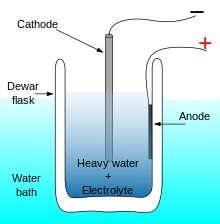
Here is a simple example of the lab setup for electrolysis:
The media flocked to the prospect of a cheap source of energy that didn't require depletable products. But most physicists were skeptical, especially of any reaction that produced more energy than what was put in. The reported results could not be reproduced by other labs; and eventually Pons and Fleischmann were discredited. However, some groups continued to experiment, particularly the U.S. Navy and New Hydrogen Energy Institute in Japan.
Here is an image of the setup used by the researchers in Japan:
After 1991, cold fusion research continued in relative obscurity,
conducted by groups that had increasing difficulty securing public
funding and keeping programs open. Research continues today in a few
specific venues, but the wider scientific community has generally
marginalized the research being done and researchers have had difficulty
publishing in mainstream journals.
The Japanese group has discontinued work on cold fusion, but the groups that have continued have renamed their efforts to avoid the negative reactions of the scientific community to the term cold fusion. The new nomenclature includes:
...Low Energy Nuclear Reactions (LENR) or Chemically Assisted Nuclear Reactions (CANR), also Lattice Assisted Nuclear Reactions (LANR), Condensed Matter Nuclear Science (CMNS) and Lattice Enabled Nuclear Reactions... --Wikipedia
The U.S. Navy has a library of papers on this topic at LENR-CANR.org.
What do you think -- is it the real thing this time?