Pages

Showing posts with label fabric. Show all posts

Wednesday, May 13, 2015

DIY: sewing your own fashion

image: Vogue pattern 8806
Vogue pattern 8806, Sewing Patterns
***
Sewing can be one of the most exasperating endeavors I've encountered--can't tell you how many times I've had to re-do what I just did because I did it backward. That said, in today's retail clothing market, sometimes sewing a garment yourself is about the only way you can find/afford something unique.
***
image: Burda pattern 8108
Burda pattern 8108, Sewing Patterns
***

Probably the single most common error I make when putting together a sewing project is selecting an inappropriate fabric or print to go with the pattern.  It's best to look at the garment illustration on the pattern envelope carefully and heed the fabric suggestions on the back, unless you have a very clear idea of the look you want to create. Sewing Patterns has a good selection of patterns.

If you're new to sewing, there's a lot to learn. Getting to the stage where you can put together a Vogue Couture pattern may take years. There is a Very Easy Vogue collection that has many desirable designs and suits beginners' skills, such as the one below. While it's always best to buy the size that fits your measurements, in my experience Simplicity and McCalls patterns feel small for the measurements given.
***
image: Very Easy Vogue pattern 9115
Very Easy Vogue pattern 9115, Sewing Patterns
***

A good guide is essential; one that I've used so much it's falling apart is Simplicity Sewing Book (This links to a revised version at Amazon).

For me, one of the most pleasurable aspects of sewing is shopping for and handling fabrics. There are excellent deals and large selections online (Online Fabric Store slider), but you really should go to a local fabric store to get a sense of how light or heavy, firm or not firm, stiff or pliable--called the hand--a fabric is.

If you really don't want to open this can of worms, fulfilling as it can be, and would rather let someone else do the handiwork, take a look at sites like Etsy Clothing, ArtFire, and Rebels Market. There's a list of Etsy alternatives at Business News Daily.

-- Marge


Wednesday, April 02, 2014

DIY: Fiber sculpture

Every day (uhm, most days?) we put on apparel made of fabric, which is made of fiber and stitched together. For some artists the fabric and fiber are most interesting.  Sometimes what they do is called textile art, sometimes fabric sculpture.  Stuffed dolls, puppets, and dramatic props fit in here. Below are some ways fabric and fiber are being used creatively.

Andrea Graham makes felt and felt shapes.
***
image: felt sculpture by Andrea Graham
Andrea Graham, oganic pods, TextileArtist
***
For instructions on how to make felt and shape (needle) felt, take a look at these wikiHow articles.

Lisa Lichtenfels make fabric sculptures.
***
image: fabric sculpture by Lisa Lichtenfels
Lisa Lichtenfels, womanegg, LisaLichtenfels.net
***
She says about her art:
 Curiously, although my work has evolved over the years, my earlier styles of working have never been out of favor with me, and I love the early figures as much as ever. I still cherish my first soft sculpture, and it reminds me of the time I showed her to a college professor. He proclaimed it the “worst piece of junk” he had ever critiqued, and chastised me at length for having the gall to present it. I also remember how hurt he was that his words didn’t bother me. How could he have known that all his harsh castigation could possibly achieve was the cementing of a permanent relationship between a new artist and her work? In any case, I can’t say I explored my medium as much as followed where it took me. It has been such an enlightening, enriching, and forgiving journey that I always feel excited in the morning when I go into my studio.
Visit her techniques page for tips on how she does what she does.

Rebecca Akins makes puppets and props.
***
image: fabric puppets by Rebecca Akins
Rebecca Akins, A Puppet Couple, Prop Agenda
***
Her work and the materials she's used are reported by Eric Hart in his post, "Rebecca Akins: Surviving Forty Years of Making Props." WonderHowTo has a collection of easy movie prop ideas.

The elusive French designer, Manon Gignoux, gives new purpose to old clothes and used fabric to make dolls and other items.
***
image: fabric dolls by Manon Gignoux
Manon Gignoux, dolls, Stars
***
Sam in Sam's Notebook quotes Manon:
The clothes I create pass on the experience of living, flattering and deforming the body. My fabric dolls, each a kind of symbolic object, represent attitudes and personalities. I play on the relationship between clothes and object, I dress objects in order to protect them and to tell their story… damaged coverings, darned, made from accumulation and colours faded by time. I also set up installations in which I associate my work with objects that I have found, re-invented and/or photographed.
And photographer Eric Valdenaire beautifully catalogues her studio.

In closing, here's a company--Transformit--that makes fabric structures.  While their products look somewhat commercial, they offer great ideas for art installations and decorating.
***
image: suspended fabric form by Transformit
Transformit, suspended form
***
Transformit rents and makes-to-order a variety of shapes and gives instructions on how to set them up.

-- Marge


Wednesday, March 26, 2014

DIY: Hardened fabric sculpture

What I had in mind when I started this post was sculpture that features flowing, stiffened fabric.  After visiting many webpages and gathering enough URLs for two related posts, I came across the correct term for finding what I was looking for--hardened fabric sculpture.  Time and conditions permitting, I'll be able to work with this technique this summer.

In the meantime, gathering information is the order of the day.  Here are some images of what's in mind.
***
image:  hardened fabric sculpture by Robyn
Robyn, "Bedouin-Nomad," VivyGirl Designs
***
image: hardened fabric sculpture by Terry Kruse
Terry Kruse, "Ricki," Terrys art
***
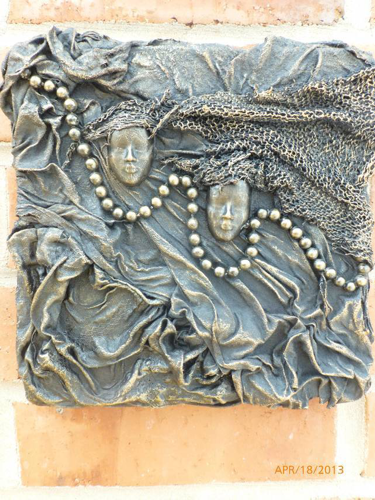
image: wall plaque by Tracey Evans
Tracey Evans, Wall Plaque, Folksy
***

Some products used to harden the fabrics are Paverpol and Fa-Brick.  A note on the Paverpol site says:
IMPORTANT: DO NOT pour Paverpol down your drain – keep a bucket of water at your workstation and rinse hands and brushes frequently. While Paverpol is water-based and non-toxic, it is made to cure rock-hard, and you don’t want it stuck in your plumbing. Periodically clean the bucket; let the material in the water settled, pour off the water into flower garden, etc. The solids that have collected at the bottom of the bucket can be disposed of in any trash receptacle.
Other substances can be used to harden fabric, such as starch, wood glue, and epoxy resin.  But I recommend using one of the commercial products because they are weather-resistant, can be installed outdoors, and are non-toxic.  No mention of UV-resistance.

The video below shows how to use a fabric hardener.  Be aware that she's using very small pieces of fabric and her method is not very economical.  Seems to me the excess hardener should be scraped off.  Also, the Helmar product is a glue and mainly used for crafts.
***
***

As you can see, the process is pretty messy.

If you're planning on creating free-standing sculptures, an armature is a good idea. You can buy them ready-made or construct your own (video below).  Note that he's using metal pipe.  If what you're hanging on the armature is fairly light (fabric usually is), PVC pipe should work. No promises, though.  There are two things to keep in mind: if the armature fails, the work sags or even collapses and the final weight of the piece (metal is heavier than PVC).  Seems like some experimentation may be needed.
***
***


-- Marge